Showing posts with label Climate Change. Show all posts

Feb 2, 2019

Rivers in Crisis:Water theft and corruption in the Darling River system

by Elena Garcia 

 
After a blue green algal bloom deprived the water of oxygen and left a million dead fish along a 40km section of the Darling River at Menindee Lakes, and as the massive NSW drought leaves rural communities like Walgett, wildlife, graziers and stock running out of water, politicians and bureaucracies are holding endless inquiries to appear to be dealing with the crisis. However they have been very slow to implement recommendations, and there are few moves to get more water into the river system or to deal with the mismanagement that is letting the river dry out.

Meanwhile Federal Drought Envoy Barnaby Joyce is rubbishing claims that corruption within the Murray Darling Basin Authority is to blame. “It’s not corruption. That’s a load of garbage,” he told 2GB’s Steve Price on January 11. “What we have is a massive drought. This is one of the worst on record.”

Joyce denied claims from locals that big irrigators up north are being given unfair access to water, leaving none for those down river. Instead he blamed a combination of two factors- that cool weather killed the algal bloom in the drought-reduced water, taking oxygen out of the water and killing the fish. And “bad management” which he said released water from Menindee Lakes for Adelaide use, to flow out the barrages.
 

Jul 24, 2017

Dreaded weather event twice as common within 35 years: CSIRO

RELATED: Warming whacks wheat yield ; Tougher times for marginal cropping country
DRY, damaging extreme El Niño weather events will be twice as common in a warming world.
Australia is set to suffer at least twice as many extreme El Niño weather events by 2050, even if international efforts to limiting the rise in global mean temperature to 1.5° Celsius are successful.
That’s the unhappy news from new CSIRO research, published today in Nature Climate Change, which projected the the number of extreme El Niño events would grow from four every 100 years to 10 events every 100 years.
The 2015 Paris climate agreement set a warming reduction target for 195 United Nations signatory countries (except the US, which withdrew this year). It aimed to curb carbon emissions to a level where the rise in mean global temperature are restricted to 1.5°C.
But even if efforts to stabilise warming are successful, and the temperature is stabilised at 1.5°C above the current average, extreme El Niños will continue to grow in frequency, reaching 14 every 100 years by 2150.
 

Jul 21, 2017

Hot, Dry and Deadly

A new climate change report has made some dire forecasts for the survival of threatened species and the future of farming in central and southern New South Wales.
The Hot, Dry and Deadly report by the state's peak environmental organisation, the Nature Conservation Council, is based on peer-reviewed scientific data on the impact of global warming.
It predicts that by 2090 the Southern Tablelands will face temperature increases of nearly four degrees, combined with an almost 50 per cent reduction in annual rainfall. -- ABC Report

We have so much to lose

Climate change will have profoundly negative impacts on nature in NSW if we do not urgently reduce greenhouse gas emissions. NSW has a stunning variety of species and ecosystems, with outstanding rainforests, eucalypt forests and woodlands, grasslands, wetlands, coastal heaths, alpine habitats and arid shrub lands. These ecosystems are home to more than 900 animal species, almost 4,700 plants species, and countless insect and fungi species. Since European settlement, native ecosystems and species in NSW have declined significantly. Almost 40% of native vegetation has been cleared, and what’s left is highly degraded. Only 9% is in good condition.
More than 100 species have become extinct since 1788, and over 1000, including 60% of all mammal species, are now threatened with extinction. Key threats are land clearing, habitat fragmentation, invasive species, and changed fire regimes. Human-induced climate change has now been added as a potent part of the mix.
INTRODUCTION | FORESTS | EUCALYPT WOODLANDS | GRASSLANDS | ALPINE  | RIVERS & WETLANDS | COASTAL REGIONS | MARINE | SYDNEY BUSHLAND | AGRICULTURAL LANDS | WHAT'S DRIVING CLIMATE CHANGE | CONCLUSIONS | FULL REPORT

Jun 1, 2017

New book looks at how corporate power is destroying agriculture — and how it can be changed

By Lalitha Chelliah  
Sustainable Agriculture vs Corporate Greed: Small farmers, food security &
big business
By Alan Broughton & Elena Garcia
Resistance Books
104pp, pb
$15.00
This new book is vital to understand the desperate state of farming in Australia and the world. The foolish thinking behind the way world leaders propose to manage sustainable food production is clearly exposed.
In Sustainable Agriculture vs Corporate Greed, published by Resistance Books, farmers and socialist activists Alan Broughton and Elena Garcia explore the world of survival.
Broughton has enormous experience and knowledge about sustainable farming. He has worked in or studied experiences in Venezuela, Thailand, Tanzania, Uganda, Cuba, South Korea and Italy. He also designed and taught the first organic farming diploma course in Australia.

Aug 14, 2016

Millions face drought and famine in Southern Africa

Africa drought UN Food and Agriculture Organization
News Release, July 29, 2016
Worst drought in 35 years causes crop failures, widespread malnutrition in 10 countries. More than 640,000 drought-related livestock deaths have been reported due to lack of pasture, lack of water and disease outbreaks. 

With only a few weeks before land preparation begins for the next main cropping season, some 23 million people in Southern Africa urgently need support to produce enough food to feed themselves and thus avoid being dependent on humanitarian assistance until mid 2018, FAO said today.

A FAO-prepared response plan aims to ensure that seeds, fertilizers, tools, and other inputs and services, including livestock support, are provided to small-holder farmers, agro-pastoralists and pastoralists to cope with the devastating impact of an El Niño-induced drought in the region.

At least $109 million in funding is required to provide this urgently needed support.

Farmers must be able to plant by October and failure to do so will result in another reduced harvest in March 2017, severely affecting food and nutrition security and livelihoods in the region, FAO warned.

Aug 12, 2016

Stopping land clearing and replanting trees could help keep Australia cool in a warmer future

By Clive McAlpine,  Jozef Syktus and  Leonie Seabrook .


In Queensland in 2013–14, 278,000 hectares of native vegetation were cleared (1.2 times the size of the Australian Capital Territory). A further 296,000ha were cleared in 2014–15. These are the highest rates of deforestation in the developed world.

Land clearing on this scale is bad for a whole host of reasons. But our research shows that it is also likely to make parts of Australia warmer and drier, adding to the effects of climate change.

Land clearing releases greenhouse gases into the atmosphere, but the effect of land clearing on climate goes well beyond carbon emissions. It causes warming locally, regionally and even globally, and it changes rainfall by altering the circulation of heat and moisture.

Aug 10, 2016

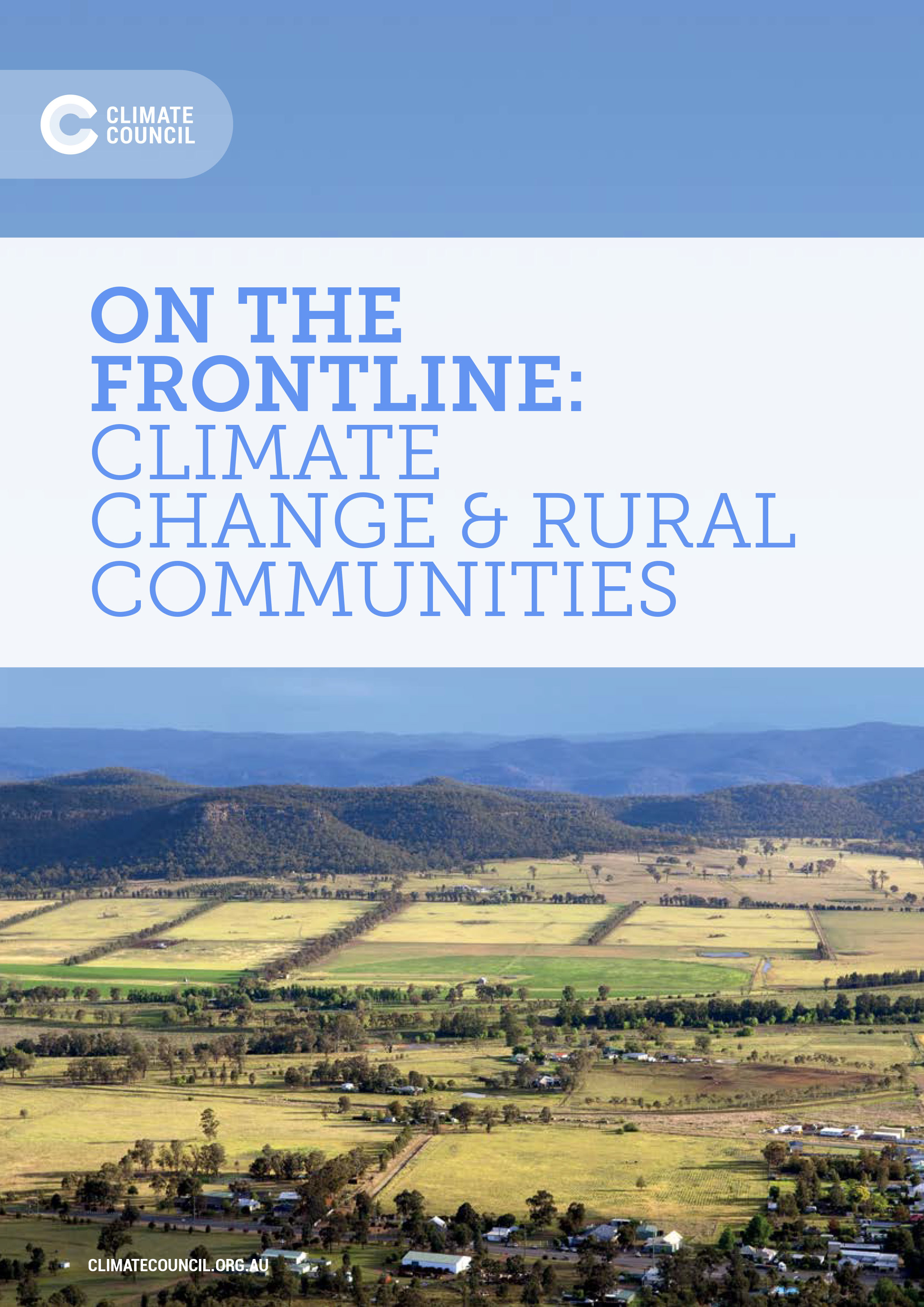
On the Frontline: Climate Change & Rural Communities

The new report from the Climate Council reveals that climate change is likely to worsen the systemic disadvantages suffered by rural and regional communities, and further widen the gap between rural and urban areas. 
The 'On the Frontline: Climate Change & Rural Communities' report finds the increase in extreme weather events is disproportionately affecting those in rural areas, with serious social, health and economic impacts. 

  1. Rural and regional communities are disproportionately affected by the impacts of climate change.
  2. The systemic disadvantages experienced by rural and regional communities over those in urban areas are likely to worsen if climate change continues unabated.
  3. Rural and regional communities are already adapting to the impacts of climate change but there are limits and costs.
  4. While rural and regional communities are on the frontline of climate change impacts, tackling climate change also provides these communities with many opportunities

Jul 15, 2016

Why changing our diet won't save the Earth

By Martin Empson

Diet of Austerity: Class, Food & Climate Change
By Elaine Graham-Leigh
Zero Books, 2015

Like the author of this interesting book on food and climate change, I have been struck by the way that the question of diet, and in particular meat eating, has become central to debates on tackling climate change.

In her introduction, Elaine Graham-Leigh notes the many ways that advocates for non-meat diets are inserting this message into the climate movement. Slogans that argue that only vegetarian diets can save the planet, or that genuine environmentalists are vegan, are common place.

But the argument has also reached higher levels, with NGOs, governments and politicians frequently advocating this approach.

Graham-Leigh's book is a challenge to this approach. She rightly argues that the danger is that veganism fails to address the real causes of climate change, will not actually have the desired effects and, most importantly, shifts the focus of blame for climate change onto predominately working class people.

Unusually for a book on the environment, class is a central part of Graham-Leigh's book. She notes that “as with discussions of austerity, it seems that those who have the least are the ones who have the greatest responsibility to be restrained in consuming it”.

Read more >>

Apr 22, 2016

Ruminant livestock and greenhouse gases

By Alan Broughton 

Within the climate change action movement there is a stream that places priority on reduction in livestock numbers as the key strategy to reduce greenhouse gases. I believe this is mistaken. The choice to not eat meat or other animal products should be regarded as a personal choice, not an ecological choice. There is no ecological justification for advocating a drastic reduction in livestock numbers as part of climate change mitigation. Efforts would be better spent in focusing on the real issues: energy generation, transport and the sustainability of farming systems. 

Livestock production can become an effective carbon sink with great potential to modify the greenhouse gas effect. The obstacle is not livestock but how the animals are managed. This essay addresses the ability of well managed grasslands to sequester the methane produced by grazing ruminant animals and some of the carbon dioxide in the atmosphere produced by industry. 


Jan 30, 2016

Behind the corporate takeover of Australian agricultural land and farms


As the demand for Australian farm products skyrockets in Asia, corporate Australia is buying up drought-crippled but viable rural properties at bargain prices.
Conservative federal MP Bob Katter proposed legislation late last year that would force banks to allow farmers two years to sell foreclosed properties instead of forcing 6-week fire sales. Katter cited sources in the agricultural industry on forced bank sales, saying that with only two months to sell, a farmer would be lucky to get 40% of market value for their property, but with two years to sell a farmer could expect to obtain 80% of market value.
The legislation would also stop banks imposing confidentiality agreements that allow them to bully their victims with a range of dirty tricks, now being investigated by a Senate banking inquiry.
Action is being mounted in the Federal Court alleging that ANZ forced farmers into “engineered defaults” and entrapped them into signing changed loan contracts when it bought out the loan book of the Landmark group in 2009.
This corporate bullying has a terrible social cost. Lifeline figures show that when a severe drought hits a rural community and financial and emotional stress levels climb, suicide rates increase sixfold.
A new Rural Bank
A record 86% of Queensland is now drought-declared, following three failed wet seasons. Many farmers are without the funds to re-stock their properties when the drought breaks. It is in this context that the banks are forcing foreclosures of properties that have not defaulted on mortgage payments and selling them at only 40% of market value.
There is a dire need for a government with vision to re-establish a Rural Bank to offer long-term loans at 2% interest and cheap farm insurance to viable, sustainable rural businesses, so that farmers and their communities can continue to produce clean affordable food, manage the Australian landscape to minimise bushfires and keep our water catchments clean.

Jan 23, 2016

Sustainable Australian agriculture under corporate attack from mining, banks and agribusinesses

A new wave of land grabbing is turning farmland into industrial monocultures.
In the past few years, private investors backed by corporate interests such as global banks, financial firms, hedge funds and food giants have bought a huge amount of farmland across the global South.
Oxfam's 2012 Our Land, Our Lives report on land grabbing said foreign investors had bought enough land in the past decade to feed 1 billion people. Oxfam singled out the World Bank, which has boosted its finance of intensive, large-scale agriculture in the global South from $2.5 billion a year in 2008 to $9.5 billion in November 2012.
The World Bank refused Oxfam's call to put a freeze on its loans to land grabbers, saying its investments were not adding to the food crisis, but providing “major new investment in agriculture to improve the productivity of large and small farmers while protecting the environment”.
However these investments are being used by corporations to buy up prime food-producing land, just as free trade treaties come into play that will allow them to sue governments that affect their profits by attempting to regulate their use of that land.
As at least two-thirds of the land grabbers intend to “export everything they produce”, Oxfam said these business plans “will come into direct conflict with the need for more land to feed a growing global population”. Most firms that take the World Bank's money use the land to produce biofuels to feed cars, or commodities to sell on overseas markets.
Researchers Shepard Daniel and Anuradha Mittall said in a 2009 study: “Not only does land grabbing mean that farmers will lose their land, but these lands will be transformed from smallholdings or communal lands into large industrial estates connected to far-off markets.”
The new wave of land grabbing is also turning the farmland into industrial monocultures, which rely heavily on chemical inputs and produce huge greenhouse gas emissions.

Jan 16, 2016

Ruminants and methane: Not the fault of the animals

Cattle and sheep are blamed for contributing to greenhouse gases, belching out methane, and farmers in the future are likely to be taxed because of it.
The recent Green Left Weekly climate change liftout [issue #1078] calls for a drastic reduction in sheep and cattle numbers. There is a TV advertisement, urging people to “go vego to save the planet”. This is a gross misunderstanding of the ruminant carbon cycle.
Ruminants have always emitted methane; it is not something new. Huge herds of wild buffalo, cattle, goats, sheep, deer, cameloids and wildebeest have grazed the grasslands of the world for millions of years. The American prairies once supported greater numbers of bison than they now do cattle, despite the intensive corn and soy production that feeds them.
Methane emissions from wild ruminants was never a problem because nature does not permit waste — the methane was used as food for methanotrophic bacteria in the soil and neutralised. It was never a problem until agricultural practices started destroying these methanotrophic bacteria, which are very sensitive to chemical fertilisers and herbicides. These bacteria reactivate in biologically managed soil.
However, methane is not the whole picture. When the contribution of livestock to soil carbon sequestration is taken into account it is easy to see that ruminants do not increase greenhouse gases if they are managed well.
Grassland soils are the greatest sequesters of carbon — greater than forests. In the top one metre of soils in temperate grasslands there is an average of 236 tonnes of carbon, compared to 96 in temperate forest soils and 80 in cropland.