Showing posts with label Methane. Show all posts

Jun 1, 2017

New book looks at how corporate power is destroying agriculture — and how it can be changed

By Lalitha Chelliah  
Sustainable Agriculture vs Corporate Greed: Small farmers, food security &
big business
By Alan Broughton & Elena Garcia
Resistance Books
104pp, pb
$15.00
This new book is vital to understand the desperate state of farming in Australia and the world. The foolish thinking behind the way world leaders propose to manage sustainable food production is clearly exposed.
In Sustainable Agriculture vs Corporate Greed, published by Resistance Books, farmers and socialist activists Alan Broughton and Elena Garcia explore the world of survival.
Broughton has enormous experience and knowledge about sustainable farming. He has worked in or studied experiences in Venezuela, Thailand, Tanzania, Uganda, Cuba, South Korea and Italy. He also designed and taught the first organic farming diploma course in Australia.

Aug 9, 2016

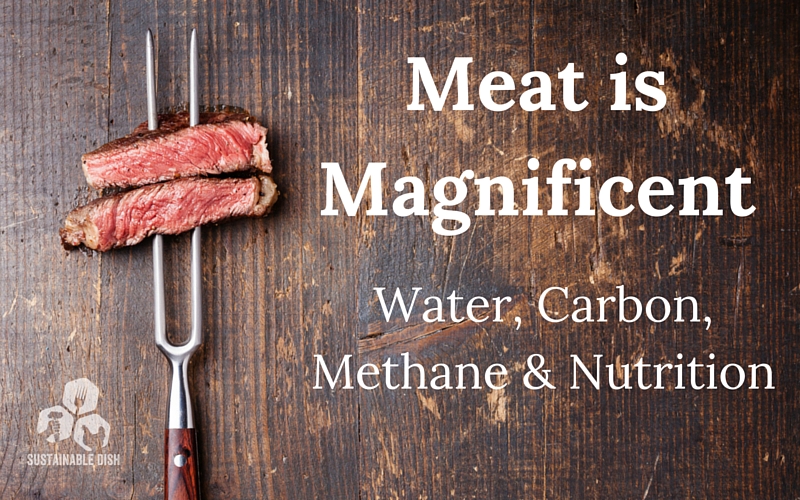
Diana Rodgers: Meat is Magnificent: Water, Carbon, Methane & Nutrition

There was a recent article in The Washington Post entitled “Meat is Horrible”, once again vilifying meat, that was full of inaccurate statements about the harm cattle impose on the land, how bad it is for our health, and how it should be taxed. Stories like this are all too common and we’ve absolutely got to change our thinking on what’s causing greenhouse gas emissions and our global health crisis.

Hint: it’s not grass-fed steak

In the few days since the story originally came out, I’ve been brewing up some different angle to write. I’ve written here, and here about the benefits of red meat, and how Tofurky isn’t the answer to healing the environment or our health. I keep saying the same thing over and over. Recently, I posted this as a response to Arnold Schwarzenegger’s new claims that a plant-based diet is optimal. I also wrote about Philadelphia’s sugar tax here, and I don’t think a meat tax is any better of an idea, especially when the government is subsidizing the feed. I’m feeling quite frustrated.

This morning, I went back to see the post and noticed that the story has been “significantly revised to address several inaccurate and incomplete statements about meat production’s contribution to greenhouse gas emissions.” Most of the original points, references and charts are missing. However there are still some important pieces of information that I feel the author missed. The main one being that meat itself isn’t evil, it’s the method by which we farm it (feed lots and CAFOs-Confined Animal Feeding Operations) and how we prepare it (breaded and deep fried), and what we eat alongside it (fries, and a large soda).

Stop hating the player and instead, hate the game. Humans have been eating meat for all of our existence. Why vilify it now? I think what most people are really upset with are modern agricultural techniques and hyper-palatable, ultra-processed foods. Those are the real issue here, not a grass-fed steak. I’ll address some of the points directly:

Read more >>

Apr 22, 2016

Ruminant livestock and greenhouse gases

By Alan Broughton 

Within the climate change action movement there is a stream that places priority on reduction in livestock numbers as the key strategy to reduce greenhouse gases. I believe this is mistaken. The choice to not eat meat or other animal products should be regarded as a personal choice, not an ecological choice. There is no ecological justification for advocating a drastic reduction in livestock numbers as part of climate change mitigation. Efforts would be better spent in focusing on the real issues: energy generation, transport and the sustainability of farming systems. 

Livestock production can become an effective carbon sink with great potential to modify the greenhouse gas effect. The obstacle is not livestock but how the animals are managed. This essay addresses the ability of well managed grasslands to sequester the methane produced by grazing ruminant animals and some of the carbon dioxide in the atmosphere produced by industry. 


Mar 30, 2016

Blather Vox Pop : the biological farmer

Alan Broughton is a biological agriculture researcher and organic farming teacher based in Eastern Victoria. He has had extensive experience in farm management and setup both here  in Australia and  overseas.
Dave Riley  discusses with him some  of the assumptions being made about livestock as climate change drivers  and how a new approach to grazing animals can impact on the sustainable ecology of agriculture. 


Jan 30, 2016

Behind the corporate takeover of Australian agricultural land and farms


As the demand for Australian farm products skyrockets in Asia, corporate Australia is buying up drought-crippled but viable rural properties at bargain prices.
Conservative federal MP Bob Katter proposed legislation late last year that would force banks to allow farmers two years to sell foreclosed properties instead of forcing 6-week fire sales. Katter cited sources in the agricultural industry on forced bank sales, saying that with only two months to sell, a farmer would be lucky to get 40% of market value for their property, but with two years to sell a farmer could expect to obtain 80% of market value.
The legislation would also stop banks imposing confidentiality agreements that allow them to bully their victims with a range of dirty tricks, now being investigated by a Senate banking inquiry.
Action is being mounted in the Federal Court alleging that ANZ forced farmers into “engineered defaults” and entrapped them into signing changed loan contracts when it bought out the loan book of the Landmark group in 2009.
This corporate bullying has a terrible social cost. Lifeline figures show that when a severe drought hits a rural community and financial and emotional stress levels climb, suicide rates increase sixfold.
A new Rural Bank
A record 86% of Queensland is now drought-declared, following three failed wet seasons. Many farmers are without the funds to re-stock their properties when the drought breaks. It is in this context that the banks are forcing foreclosures of properties that have not defaulted on mortgage payments and selling them at only 40% of market value.
There is a dire need for a government with vision to re-establish a Rural Bank to offer long-term loans at 2% interest and cheap farm insurance to viable, sustainable rural businesses, so that farmers and their communities can continue to produce clean affordable food, manage the Australian landscape to minimise bushfires and keep our water catchments clean.

Jan 16, 2016

Ruminants and methane: Not the fault of the animals

Cattle and sheep are blamed for contributing to greenhouse gases, belching out methane, and farmers in the future are likely to be taxed because of it.
The recent Green Left Weekly climate change liftout [issue #1078] calls for a drastic reduction in sheep and cattle numbers. There is a TV advertisement, urging people to “go vego to save the planet”. This is a gross misunderstanding of the ruminant carbon cycle.
Ruminants have always emitted methane; it is not something new. Huge herds of wild buffalo, cattle, goats, sheep, deer, cameloids and wildebeest have grazed the grasslands of the world for millions of years. The American prairies once supported greater numbers of bison than they now do cattle, despite the intensive corn and soy production that feeds them.
Methane emissions from wild ruminants was never a problem because nature does not permit waste — the methane was used as food for methanotrophic bacteria in the soil and neutralised. It was never a problem until agricultural practices started destroying these methanotrophic bacteria, which are very sensitive to chemical fertilisers and herbicides. These bacteria reactivate in biologically managed soil.
However, methane is not the whole picture. When the contribution of livestock to soil carbon sequestration is taken into account it is easy to see that ruminants do not increase greenhouse gases if they are managed well.
Grassland soils are the greatest sequesters of carbon — greater than forests. In the top one metre of soils in temperate grasslands there is an average of 236 tonnes of carbon, compared to 96 in temperate forest soils and 80 in cropland.