Showing posts with label Monoculture. Show all posts

Sep 1, 2017

The Green Revolution: Effects in Asia and implications for Africa

by Alan Broughton 
Introduction

The term Green Revolution refers to the introduction of high-yielding varieties of staple food crops, particularly wheat and rice, into Third World countries, starting in the 1960s. Initially Mexico, India and the Philippines were targeted. The stated aim was to increase food production to end hunger and prevent uprisings. 

The Green Revolution did increase agricultural production, and no more successful revolutionary uprisings occurred, but it failed to reduce hunger and poverty, improve nutrition, or protect the environment. While some of these failures are now acknowledged by the proponents, the answer is that “there was no alternative”, and that for untouched areas of the world, particularly Africa, there is still no alternative. However, that alternative does exist: it is called agroecology. Science takes credit for successes but takes no responsibility for failures (Shiva 2001). 

The Green Revolution was promoted by the Ford and Rockefeller Foundations, the World Bank and the US government. The most immediate aim was to prevent revolution in the Third World. The Western world had lost China and Cuba and was in the process of losing Vietnam; there were insurgencies in Malaya and the Philippines and uncertainty about President Soekarno in Indonesia. It was decided to fight revolution with food (Cleaver 1972). “The only way to prevent a Red Revolution is to promote a Green Revolution” – Peer Maurin of Catholic Worker, and “Where hunger goes, Communism follows” – Rieff (Patel 2013). President Macapagal in the Philippines said: “We consider this institute [the International Rice Research Institute which developed the new rice varieties] as a potent weapon in the struggle against poverty and communism in Asia” (Patel 2013). 

An unstated secondary aim was to increase the penetration of agribusiness into the Third World. Profits could be made by selling the new varieties of seed and the fertilisers, pesticides and equipment (tractors, pumps) that were indispensable to their success. American fertiliser companies were looking for new markets after the Second World War when nitrate was less needed for bomb making; Norman Borlaug, the plant breeder who developed the first new high-yielding crop varieties, emphasised the importance of fertilisers to Indian politicians, and both the World Bank and US Aid for International Development (USAID) strongly pushed for increased fertiliser use (Shiva 2001). Part of the strategy of US AID funding was to increase chemical fertiliser use; this is now the strategy used in Africa, where in many countries the majority of department of agriculture spending is allocated to fertiliser subsidies (African Centre for Biodiversity 2016).

Jun 1, 2017

New book looks at how corporate power is destroying agriculture — and how it can be changed

By Lalitha Chelliah  
Sustainable Agriculture vs Corporate Greed: Small farmers, food security &
big business
By Alan Broughton & Elena Garcia
Resistance Books
104pp, pb
$15.00
This new book is vital to understand the desperate state of farming in Australia and the world. The foolish thinking behind the way world leaders propose to manage sustainable food production is clearly exposed.
In Sustainable Agriculture vs Corporate Greed, published by Resistance Books, farmers and socialist activists Alan Broughton and Elena Garcia explore the world of survival.
Broughton has enormous experience and knowledge about sustainable farming. He has worked in or studied experiences in Venezuela, Thailand, Tanzania, Uganda, Cuba, South Korea and Italy. He also designed and taught the first organic farming diploma course in Australia.

Aug 9, 2016

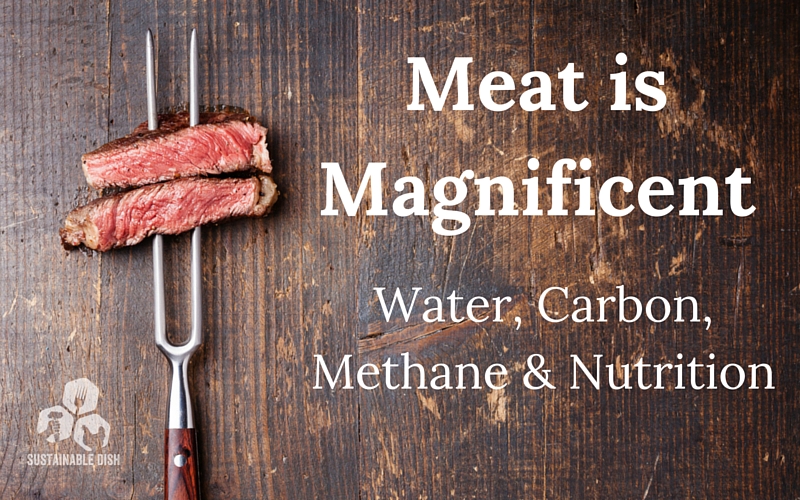
Diana Rodgers: Meat is Magnificent: Water, Carbon, Methane & Nutrition

There was a recent article in The Washington Post entitled “Meat is Horrible”, once again vilifying meat, that was full of inaccurate statements about the harm cattle impose on the land, how bad it is for our health, and how it should be taxed. Stories like this are all too common and we’ve absolutely got to change our thinking on what’s causing greenhouse gas emissions and our global health crisis.

Hint: it’s not grass-fed steak

In the few days since the story originally came out, I’ve been brewing up some different angle to write. I’ve written here, and here about the benefits of red meat, and how Tofurky isn’t the answer to healing the environment or our health. I keep saying the same thing over and over. Recently, I posted this as a response to Arnold Schwarzenegger’s new claims that a plant-based diet is optimal. I also wrote about Philadelphia’s sugar tax here, and I don’t think a meat tax is any better of an idea, especially when the government is subsidizing the feed. I’m feeling quite frustrated.

This morning, I went back to see the post and noticed that the story has been “significantly revised to address several inaccurate and incomplete statements about meat production’s contribution to greenhouse gas emissions.” Most of the original points, references and charts are missing. However there are still some important pieces of information that I feel the author missed. The main one being that meat itself isn’t evil, it’s the method by which we farm it (feed lots and CAFOs-Confined Animal Feeding Operations) and how we prepare it (breaded and deep fried), and what we eat alongside it (fries, and a large soda).

Stop hating the player and instead, hate the game. Humans have been eating meat for all of our existence. Why vilify it now? I think what most people are really upset with are modern agricultural techniques and hyper-palatable, ultra-processed foods. Those are the real issue here, not a grass-fed steak. I’ll address some of the points directly:

Read more >>

Jan 30, 2016

Behind the corporate takeover of Australian agricultural land and farms


As the demand for Australian farm products skyrockets in Asia, corporate Australia is buying up drought-crippled but viable rural properties at bargain prices.
Conservative federal MP Bob Katter proposed legislation late last year that would force banks to allow farmers two years to sell foreclosed properties instead of forcing 6-week fire sales. Katter cited sources in the agricultural industry on forced bank sales, saying that with only two months to sell, a farmer would be lucky to get 40% of market value for their property, but with two years to sell a farmer could expect to obtain 80% of market value.
The legislation would also stop banks imposing confidentiality agreements that allow them to bully their victims with a range of dirty tricks, now being investigated by a Senate banking inquiry.
Action is being mounted in the Federal Court alleging that ANZ forced farmers into “engineered defaults” and entrapped them into signing changed loan contracts when it bought out the loan book of the Landmark group in 2009.
This corporate bullying has a terrible social cost. Lifeline figures show that when a severe drought hits a rural community and financial and emotional stress levels climb, suicide rates increase sixfold.
A new Rural Bank
A record 86% of Queensland is now drought-declared, following three failed wet seasons. Many farmers are without the funds to re-stock their properties when the drought breaks. It is in this context that the banks are forcing foreclosures of properties that have not defaulted on mortgage payments and selling them at only 40% of market value.
There is a dire need for a government with vision to re-establish a Rural Bank to offer long-term loans at 2% interest and cheap farm insurance to viable, sustainable rural businesses, so that farmers and their communities can continue to produce clean affordable food, manage the Australian landscape to minimise bushfires and keep our water catchments clean.