
Poisoning Our Children: The Parent’s Guide to the Myths of Safe Pesticides,
By André Leu, 2018,
André Leu is an organic tropical fruit grower at Daintree in North Queensland. He is the former president of the International Federation of Organic Agriculture Movements(IFOAM), the peak world organic farming body.
 This book shows there is plenty of peer-reviewed science finding monumental faults with pesticide use and regulation, science that regulators do not use in their deliberations. André Leu uses this science to show that pesticide safety is based on data-free myths.
There are five myths: that pesticides are rigorously tested, that residues in food are so small they are harmless, that pesticides quickly biodegrade, that regulations are reliable, and that pesticides are essential for agriculture.
A total of 232 chemicals have been found in placental cord blood of newborn babies in the United States. Many of these are endocrine disruptors, affecting the developing brain and hormones of children. No safety tests are done on the young – all are performed on adolescent or adult animals (usually rats). Even minute amounts are dangerous for foetuses and babies. Some pesticides, for example glyphosate, the most widely used herbicide in theworld, have a greater effect on hormones in parts per billion than in parts per million. This is because the body can recognise higher amounts and reject them.
Published by Acres USA, 205pp.
Reviewed by Alan Broughton.
André Leu is an organic tropical fruit grower at Daintree in North Queensland. He is the former president of the International Federation of Organic Agriculture Movements(IFOAM), the peak world organic farming body.
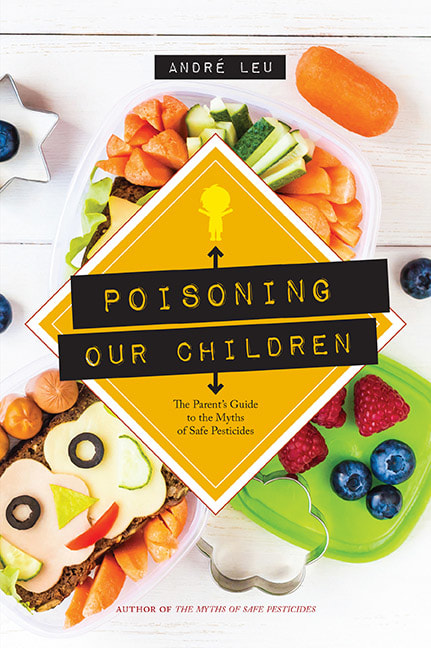 This book shows there is plenty of peer-reviewed science finding monumental faults with pesticide use and regulation, science that regulators do not use in their deliberations. André Leu uses this science to show that pesticide safety is based on data-free myths.
There are five myths: that pesticides are rigorously tested, that residues in food are so small they are harmless, that pesticides quickly biodegrade, that regulations are reliable, and that pesticides are essential for agriculture.
A total of 232 chemicals have been found in placental cord blood of newborn babies in the United States. Many of these are endocrine disruptors, affecting the developing brain and hormones of children. No safety tests are done on the young – all are performed on adolescent or adult animals (usually rats). Even minute amounts are dangerous for foetuses and babies. Some pesticides, for example glyphosate, the most widely used herbicide in theworld, have a greater effect on hormones in parts per billion than in parts per million. This is because the body can recognise higher amounts and reject them.


