Showing posts with label Rural Communities. Show all posts

Oct 18, 2019

Is NSW deliberating shutting down towns to mine underground?

“It seems that towns in western New South Wales are being shut down and nobody is listening,” local resident Mark Merritt told Green Left Weekly on the banks of a non-existent river.
Together with Susie Peake and Cath Eaglesham from Earthling Studios, Merritt attended an event organised on the Baaka River (the local Aboriginal name for the Darling River) as part of the Yaama Ngunna Baaka Corroborree Festival tour held between September 29 and October 4.
The tour was organised by Uncle Bruce Shillingsworth to expose the state of the Baaka.
Broken Hill’s water has always come from the Menindee Lakes, a gigantic lake system in the middle of a semi-arid desert that contains water bodies more than 15 kilometres wide.
In 1949, infrastructure works modified the lakes to act as huge water storages to mitigate flooding and hold water supplies for South Australia. A more than 30-kilometre long levy was built along the eastern bank of the Baaka to form a human-made lake, named Lake Wetherell, as an additional water storage to supply the townships of Menindee, Sunset Strip and Broken Hill.
In the past 60 years Broken Hill has never run out of water.
Read more...>


Aug 11, 2017

A people's food policy for England


Stepping away from market imperatives frees our minds and thinking about food and farm production. Agriculture and food systems, the resources needed for producing food and the landscapes where this takes place are a kind of commons or a public good. The more food is viewed as a public good, the less appropri­ate it is that the productive factors needed to produce foods, seeds, land, water etc., are private property and provided by the market. ...Rethinking food as a right, farming as a management system of the planet and the food system as a commons is what I would call a real shift in paradigm (a most overused word!). It doesn’t rule out markets as one of several mechanisms for food distribu­tion, but does it reject market hegemony over our food supplies, and rejects the view that market forces are the best way of allocating food producing resources.

Read more...

Jul 21, 2017

Hot, Dry and Deadly

A new climate change report has made some dire forecasts for the survival of threatened species and the future of farming in central and southern New South Wales.
The Hot, Dry and Deadly report by the state's peak environmental organisation, the Nature Conservation Council, is based on peer-reviewed scientific data on the impact of global warming.
It predicts that by 2090 the Southern Tablelands will face temperature increases of nearly four degrees, combined with an almost 50 per cent reduction in annual rainfall. -- ABC Report

We have so much to lose

Climate change will have profoundly negative impacts on nature in NSW if we do not urgently reduce greenhouse gas emissions. NSW has a stunning variety of species and ecosystems, with outstanding rainforests, eucalypt forests and woodlands, grasslands, wetlands, coastal heaths, alpine habitats and arid shrub lands. These ecosystems are home to more than 900 animal species, almost 4,700 plants species, and countless insect and fungi species. Since European settlement, native ecosystems and species in NSW have declined significantly. Almost 40% of native vegetation has been cleared, and what’s left is highly degraded. Only 9% is in good condition.
More than 100 species have become extinct since 1788, and over 1000, including 60% of all mammal species, are now threatened with extinction. Key threats are land clearing, habitat fragmentation, invasive species, and changed fire regimes. Human-induced climate change has now been added as a potent part of the mix.
INTRODUCTION FORESTS | EUCALYPT WOODLANDS | GRASSLANDS | ALPINE  | RIVERS & WETLANDS | COASTAL REGIONS | MARINE | SYDNEY BUSHLAND | AGRICULTURAL LANDS | WHAT'S DRIVING CLIMATE CHANGE | CONCLUSIONS | FULL REPORT

Jun 1, 2017

New book looks at how corporate power is destroying agriculture — and how it can be changed

By Lalitha Chelliah  
Sustainable Agriculture vs Corporate Greed: Small farmers, food security &
big business
By Alan Broughton & Elena Garcia
Resistance Books
104pp, pb
$15.00
This new book is vital to understand the desperate state of farming in Australia and the world. The foolish thinking behind the way world leaders propose to manage sustainable food production is clearly exposed.
In Sustainable Agriculture vs Corporate Greed, published by Resistance Books, farmers and socialist activists Alan Broughton and Elena Garcia explore the world of survival.
Broughton has enormous experience and knowledge about sustainable farming. He has worked in or studied experiences in Venezuela, Thailand, Tanzania, Uganda, Cuba, South Korea and Italy. He also designed and taught the first organic farming diploma course in Australia.

Aug 10, 2016

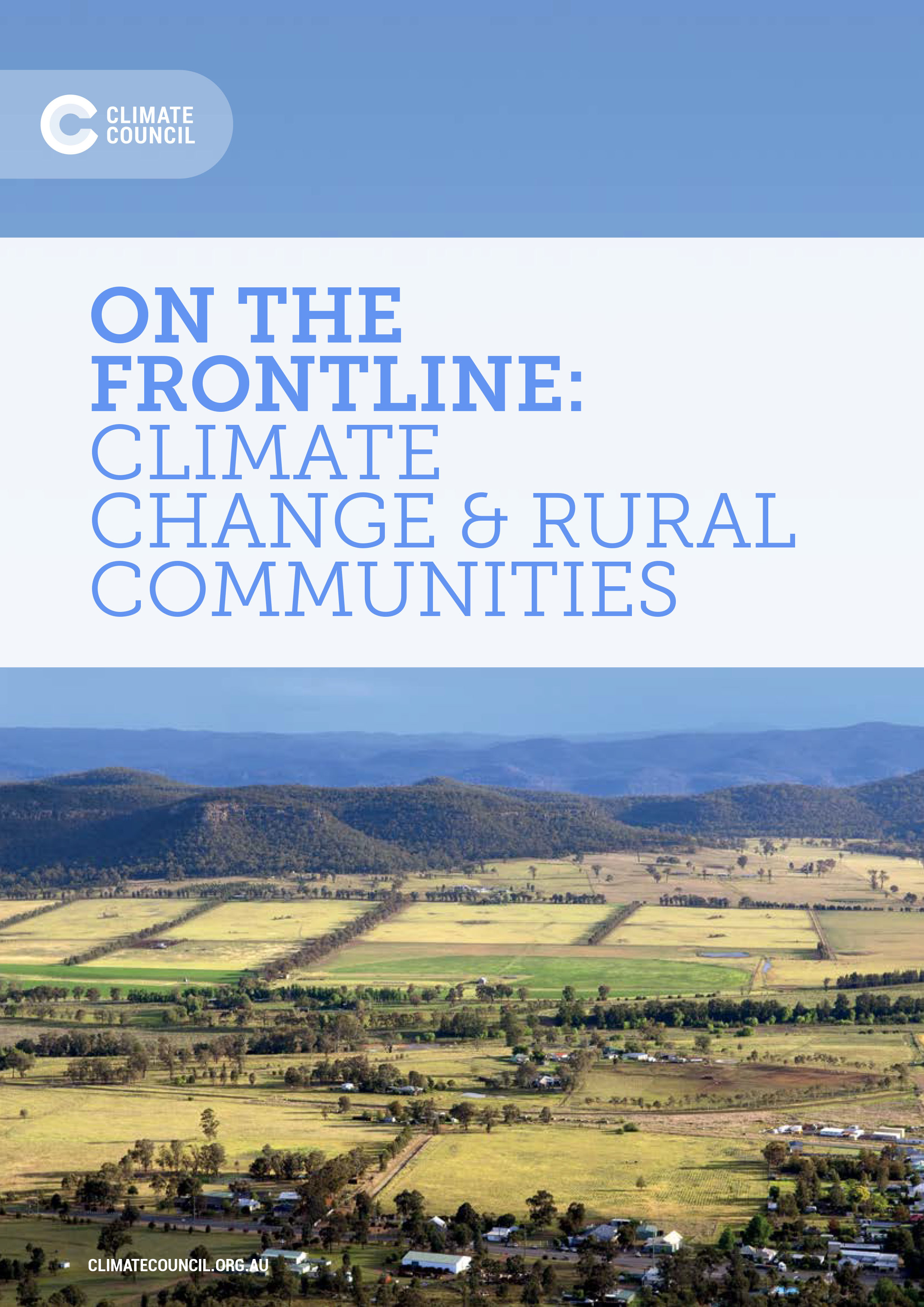
On the Frontline: Climate Change & Rural Communities

The new report from the Climate Council reveals that climate change is likely to worsen the systemic disadvantages suffered by rural and regional communities, and further widen the gap between rural and urban areas. 
The 'On the Frontline: Climate Change & Rural Communities' report finds the increase in extreme weather events is disproportionately affecting those in rural areas, with serious social, health and economic impacts. 

  1. Rural and regional communities are disproportionately affected by the impacts of climate change.
  2. The systemic disadvantages experienced by rural and regional communities over those in urban areas are likely to worsen if climate change continues unabated.
  3. Rural and regional communities are already adapting to the impacts of climate change but there are limits and costs.
  4. While rural and regional communities are on the frontline of climate change impacts, tackling climate change also provides these communities with many opportunities